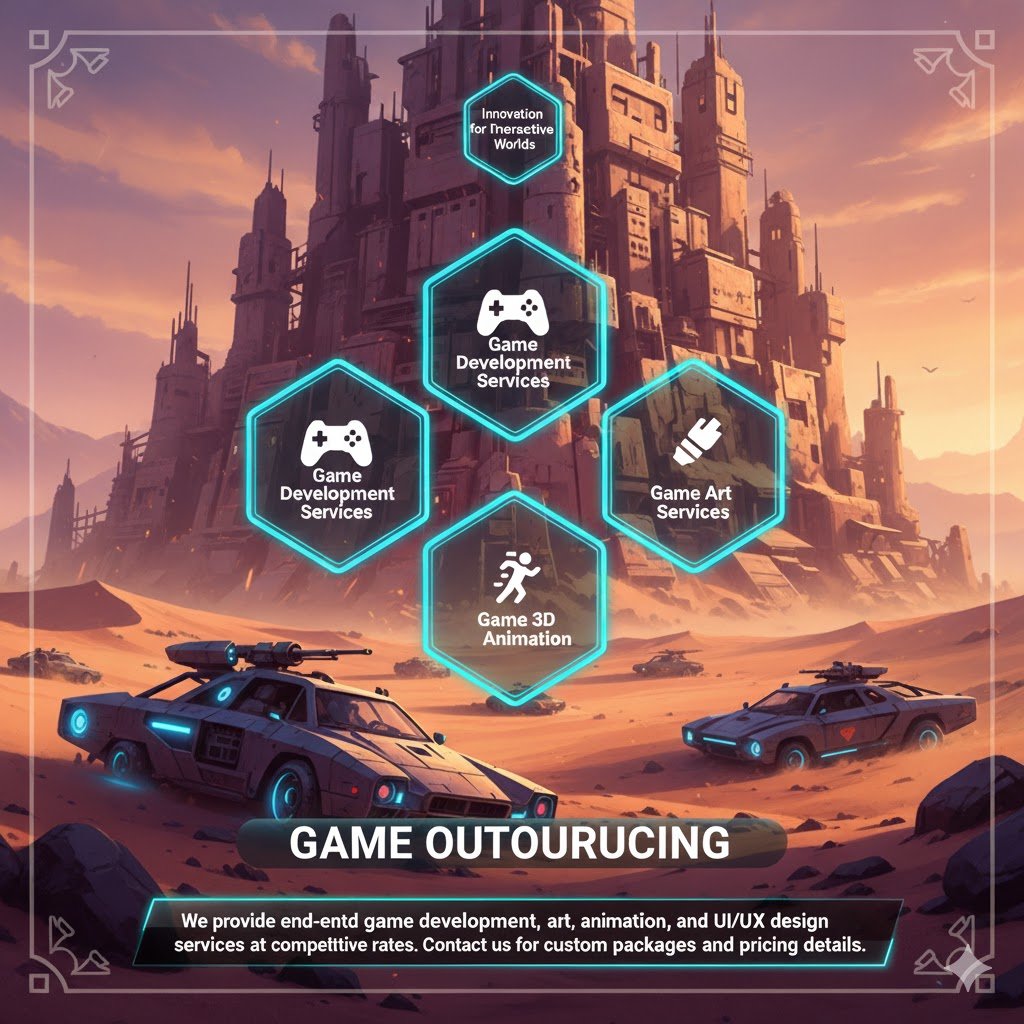
The Complete Game Design & C-Suite Creative Partnership Studio
Introduction: The Blueprint of Fun – Architecting the Player Experience
A video game is not a commodity. It is an experience. It is a curated journey of challenge, discovery, emotion, and achievement. While art provides its soul and programming provides its skeleton, it is the Game Design that provides its heart and brain. Game Design is the invisible, intangible architecture of “fun.” It is the blueprint that dictates every rule, every reward, every challenge, and every player motivation. It is, without question, the most critical, high-stakes element of development. A game with mediocre art but brilliant design can become a global phenomenon (e.g., Minecraft, Among Us). A game with brilliant art but flawed design is doomed to fail.
The challenge of modern game design is one of immense complexity. It is a multi-disciplinary field that is equal parts psychology, mathematics, economics, storytelling, and architecture. Today’s “Game Designer” must be a “systems thinker,” a “level architect,” a “narrative weaver,” and an “economic modeler” all at once. They must design systems that are not only fun for the first hour, but remain engaging for the thousandth hour. This level of expertise is extraordinarily rare and is the single greatest determinant of a project’s success.
Our studio is not an “outsourcing” firm; we are a C-Suite Creative Partner. We provide elite, world-class Game Design services as a “strike team” of veteran designers, directors, and analysts. We are the team you bring in avant you’ve hired 200 artists and engineers. We are the “architects” who design the blueprint, the “economists” who model the economy, and the “storytellers” who craft the world. Our services span the entire creative lifecycle: from the first Game Design Document (GDD) et Technical Design Document (TDD), to intricate Systems Design (combat, progression), architectural Level Design, and compelling Narrative Design.
This document is an exhaustive overview of our design-centric services. We will explore our “design-first” philosophy, our process for deconstructing “fun,” the specific, actionable deliverables we create, and the engagement models we use to function as your acting Creative Director or Design Lead. We are here to ensure your game is not just built, but designed for success.
Section 1: The Philosophy – Design as a Predictive Science
Our core philosophy is that “great game design is not an accident; it is a predictive science.” We do not rely on “gut feelings.” We employ a rigorous, analytical, and player-centric methodology to architect experiences.
1.1. The “Core Loop” as the Foundation: Every successful game, from Tetris to World of Warcraft, is built on a simple, repeatable, and rewarding “Core Loop.”
-
Notre processus : Our first task is always to define this loop. We ask:
-
Action : What is the primary thing the player does? (e.g., “Fight a monster,” “Solve a puzzle,” “Place a block”)
-
Reward: What does the player get for doing that action? (e.g., “Experience points,” “Loot,” “A new ‘tool'”)
-
Progression/Incentive: How does that reward enable the next action? (e.g., “The XP lets me level up to… fight bigger monsters.” “The tool lets me… solve new puzzles.”)
-
-
Produit livrable : The “Core Loop Diagram.” This simple, one-page flowchart is the single most important document we will create. It becomes the “constitution” for the entire project. Every feature, system, or piece of content that is proposed doit be validated against this loop. Does it support the loop? If not, it is cut.
1.2. Player-Centric Psychology (The Bartle Test): We design for specific player motivations. Not all players want the same thing.
-
Notre processus : We use established psychological frameworks (like the Bartle Test of Player Types) to define your target audience:
-
Achievers (Diamonds): They play for points, loot, et 100% completion. They need clear goals, achievements, and leaderboards.
-
Explorers (Spades): They play to discover. They need vast worlds, hidden secrets, and lore. They are the ones who will “see what’s over that mountain.”
-
Socializers (Hearts): They play for connection. They need friends lists, guilds, chat, and “non-game” activities (e.g., player housing, emotes).
-
Killers (Clubs): They play for dominance over other players. They need PvP, competition, and systems that allow them to impose their will.
-
-
Notre solution : A great game must serve at least two of these types, and a massive game must serve all four. We will design specific systems to engage each of these core motivations, ensuring your game has broad, long-lasting appeal.
1.3. Design Documentation as a “Living” Entity: The 500-page GDD is dead. It is written, filed, and never read.
-
Our Philosophy: We believe in a “Living GDD.”
-
Produit livrable : We build your game’s “Design Bible” in a collaborative, cloud-based tool like Confluence ou Miro. This is a “single source of truth” for the entière studio.
-
It is Visual: We use flowcharts, diagrams, and reference videos.
-
It is Modular: There is a “page” for the Combat System, a “page” for the AI, a “page” for Level 1.
-
It is Living: When a design is changed in a meeting, our producer updates the Confluence page that day. The entire team (artists, programmers) toujours has the most current, correct information. This single-handedly eliminates 90% of the communication breakdowns that kill projects.
-
Section 2: Core Design Service Offerings
Our services are modular, allowing you to engage us for the full project or for a specific, surgical intervention.
2.1. Service: Pre-Production & Creative Direction This is the most valuable service we offer. Hire us avant you’ve hired your 100-person team.
-
What it is: We will act as your “Interim C-Suite” (Creative Director, Design Director). We will help you take your “one-page idea” and turn it into a viable, funded, and “ready-for-production” project.
-
Produits livrables :
-
The “Pitch Deck”: A high-level, visually stunning presentation for investors and publishers.
-
The “Core Loop” & “Systems” Pitch: Detailed documents (10-20 pages) that define the “why” and “what” of your game.
-
The “Vertical Slice” Blueprint: A hyper-detailed plan for the single, 10-minute demo that will prove your concept and secure your funding. We design seulement the features needed for that slice.
-
The “Living GDD” (Genesis): We build the foundational Confluence/Wiki and populate it with the core design pillars.
-
2.2. Service: Systems Design (The “Rules”) This is the “mathematical” part of design. We architect the deep, interlocking systems that keep players engaged for 1000+ hours.
-
Types of Systems We Design:
-
Combat Systems: The “feel” of action. We design hit-boxes, damage formulas, AI behavior “trees,” weapon stats, and controller mappings.
-
Progression Systems: The “retention” loop. We design the XP curves, the “skill trees,” the “loot tables,” and the “prestige” systems. This is a mathematical science of balancing effort vs. reward.
-
Economic Systems: (See Doc 3 for a deep dive). We design the “faucets” (ways to earn currency) and “sinks” (ways to spend it) to create a stable, non-inflationary economy. This is critical for F2P and Web3 games.
-
2.3. Service: Level Design (The “Spaces”) This is the “architectural” part of design. We build the “worlds” that players explore.
-
Notre processus : We do not build “pretty” spaces. We build “functional” spaces.
-
1. “Paper” Design: We start in a 2D tool (like Miro or Illustrator) or with literal pen and paper. We “bubble-diagram” the flow of a level. “Start -> Tutorial Zone -> First Choice (Safe Path / Hard Path) -> Mini-Boss -> Key -> Locked Door -> End.”
-
2. “Blockmesh” (Grayboxing): We then go into the engine (Unity/Unreal) and build the level out of simple gray boxes. This is the most crucial step. We test the “flow,” the “sightlines,” the “cover,” and the “jump distances.” We make the level amusant when it is still ugly.
-
3. Art Pass: Only after the “Blockmesh” is tested and approved by the leads do we hand it off to the Art Team. The artists “skin” our “Blockmesh,” replacing the gray boxes with their beautiful art, knowing that the underlying gameplay is already perfect.
-
-
Produits livrables : Fully playable “Blockmesh” levels (.unity or .umap files) and the corresponding 2D “Paper Design” maps.
2.4. Service: Narrative Design (The “Story”) This is the “storytelling” part of design. It is not just “writing.” It is “integrating story into gameplay.”
-
What it is: We design the methods of storytelling.
-
Active Story: Dialogue choices, branching path “quest-lines,” and in-game “cinematics” (where the player is in control).
-
Passive Story: This is our specialty. “Environmental Storytelling.” Why tell the player there was a battle when you can show them a room with a broken table, an arrow in the wall, and a spilled wine glass? We design “vignettes” and “lore-drops” (item descriptions, audio logs) that let the player discover the story, which is infinitely more powerful.
-
-
Produits livrables : Quest-flow diagrams, branching dialogue trees (written in tools like Articy Draft ou Twine), and “lore bibles.”
Section 3: Toolchain and Technical Mastery
Game Designers do not work in a vacuum. They work at the nexus of art, engineering, and data. Our team is fluent in the entire professional toolchain.
-
Design & Prototyping Tools:
-
Miro & Figma: Our primary tools for “whiteboarding,” “brainstorming,” and creating “paper” designs (level flows, UI/UX wireframes, system diagrams).
-
Confluence & Notion: Our “Living GDD” platforms. The single source of truth.
-
Jira & Trello: We are project management experts. We write “Design Tickets” that are so clear, an engineer or artist can read it and know exactement what to build.
-
-
Engine-Native Tools:
-
Unity & Unreal Engine: Our designers are not just “idea guys.” They are “in-engine” implementers. They can build the “Blockmesh” levels. They can use Unreal’s Blueprint or Unity’s Visual Scripting to prototype their own combat or quest mechanics sans taking up an engineer’s time. This is a massive force multiplier.
-
-
Data & Economic Tools:
-
Microsoft Excel (Advanced): Do not underestimate it. All great game economies, XP curves, and loot tables are built and balanced in Excel first. We are “power users” who build complex, data-driven models.
-
Articy Draft & Twine: Specialized tools for writing and managing the massive, non-linear scripts of modern RPGs.
-
Section 4: Pricing and Engagement Frameworks
Hiring a “Game Designer” is not like ordering an “art asset.” You are hiring a “brain” and a “creative leader.” Our models are structured to be partnerships.
Model 1: The “C-Suite” Retainer (Creative Direction) This is our “Pre-Production” model. It is a high-impact, short-term (3-6 month) engagement.
-
Comment cela fonctionne-t-il ? You pay a fixed, high-value monthly retainer. This gives you direct, on-demand access to our Studio Design Director and a Lead Systems Designer.
-
Example Package: For $25,000/month, you get:
-
1x Studio Design Director (15 hours/week) – To lead creative, build the pitch deck, and interface with investors.
-
1x Lead Systems Designer (40 hours/week) – To “live in the trenches,” build the “Living GDD,” design the core loops, and model the systems in Excel.
-
-
Meilleur pour : Startups and new projects. This is the highest-value investment you can make. It “de-risks” your entire project by ensuring the blueprint is perfect avant you spend millions on production.
Model 2: The “Design Pod” Retainer (Full Production) This is our “Augmentation” model. You have a team, but you need a dedicated “Design Department.”
-
How it Borks: You pay a fixed monthly retainer for a “pod” of designers who embed with your team for the long haul (12-24 months).
-
Example “Level Design Pod”: For $22,000/month, you receive: 1x Senior Level Designer and 2x Mid-Level Level Designers. This team’s “output” is a new, fully-playable “Blockmesh” level every 3-4 weeks.
-
Example “Systems Pod”: For $18,000/month, you receive: 1x Lead Systems Designer and 1x Technical Designer. This team will own, balance, and implement the combat and progression systems for your entire game.
-
Meilleur pour : AA and AAA studios that need to scale their design workforce without the overhead of internal hiring.
Model 3: The “Design Audit” (Fixed Price) This is our “Surgical Strike” model. Your game is live, or in late-stage development, and it feels wrong.
-
Comment cela fonctionne-t-il ? We engage on a 2-4 week, fixed-price contract.
-
Example: “Retention & Monetization Audit” ($15,000): Our Lead Economy Designer will play your game for 40 hours. We will then deliver a 50-page, actionable “Audit Report” that details why your retention is low. (e.g., “Your ‘Core Loop’ breaks at hour 2,” “Your ‘new player’ churn is due to this specific UI flaw,” “You are missing three critical ‘currency sinks'”).
-
Example: “Level Flow Audit” ($10,000): Our Lead Level Designer will play your Alpha build and provide a “pain-point” report for every level, with video-annotated feedback showing exactly where players are getting lost, stuck, or bored.
-
Meilleur pour : LiveOps teams or projects in trouble. This is a “rescue” package.
Conclusion: The Architects of Fun
You have one chance to build your game. The art can be patched, the bugs can be fixed, but a fundamental flaw in the design—in the core loop, the economy, or the level flow—is almost always fatal.
Do not leave the “fun” to chance. Do not start building your “house” without an architect. We are those architects. We are the C-suite creative partners who will build your blueprint, the systems thinkers who will engineer your retention, and the creative leaders who will guide your team to a successful, engaging, and profitable launch.
Contact us for a preliminary design review. Let’s talk about your “Core Loop.”
 FR
FR  EN
EN  ES
ES  DE
DE  IT
IT
Avis
Il n’y a pas encore d’avis.